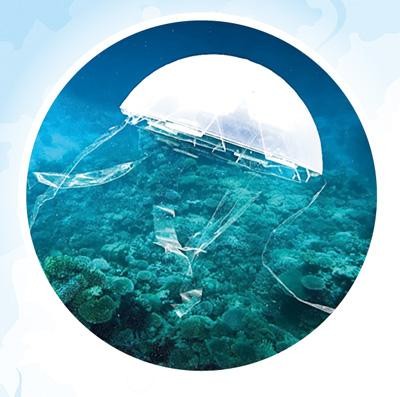
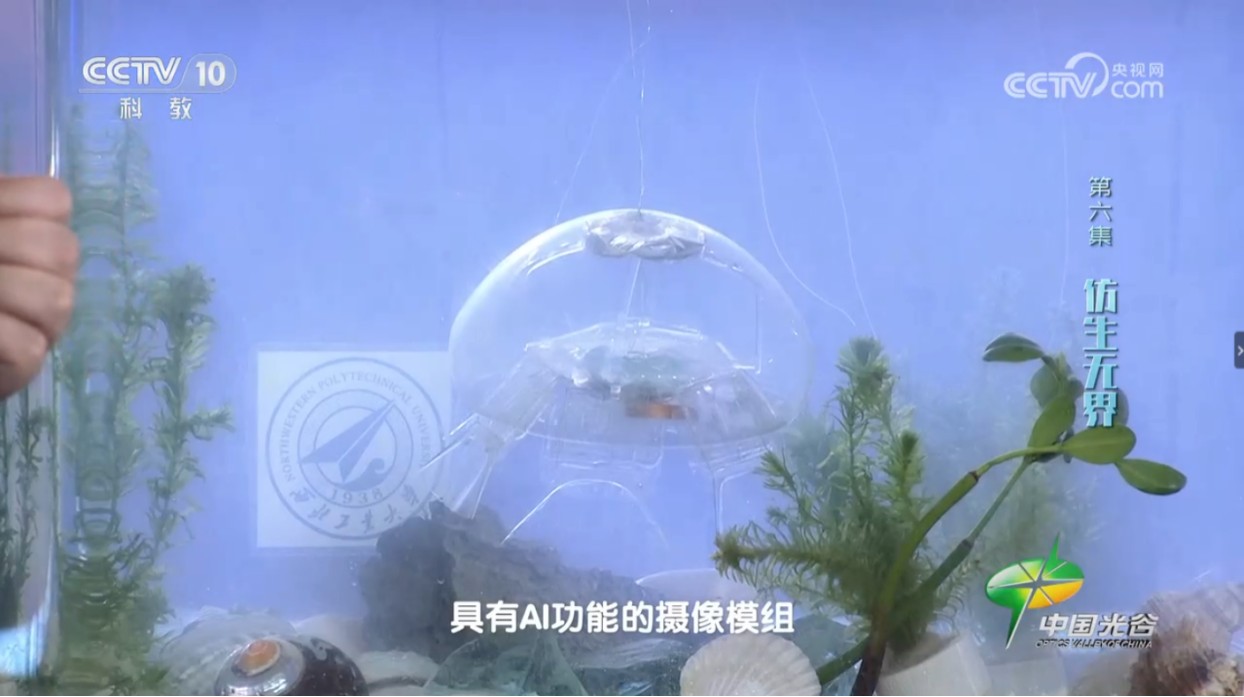
It is known as the "Underwater Ghost". With a fully transparent body, it remains nearly undetectable to the naked eye when submerged, and even passing fish show no awareness of its presence. Yet it is equipped with comprehensive functional modules, enabling real-time monitoring and full awareness of subtle underwater activities.
This extraordinary high-bionic robot is the bionic jellyfish robot independently developed by the research team led by Professor Tao Kai from the School of Mechanical Engineering, Northwestern Polytechnical University.
Recently, this remarkable bionic robot was featured in the sixth episode Bionics Without Boundaries of the CCTV program Smart Optics Valley · CMG World Robot Skills Competition.
The jellyfish robot not only boasts high bionic similarity but also integrates AI detection capabilities. It highly mimics natural jellyfish in both morphology and locomotion, and further embeds artificial intelligence (AI) deeply into the bionic platform to realize embodied intelligence in underwater environments, providing a cutting-edge solution for breaking through key bottlenecks in deep-sea exploration.

The CMG competition has gathered cutting-edge global robotic technologies, with the intelligent challenges of deep-sea operations drawing extensive attention. The "Underwater Ghost" presented by Professor Tao Kai’s team is precisely a research achievement oriented toward this major national demand, integrating bionics and artificial intelligence.
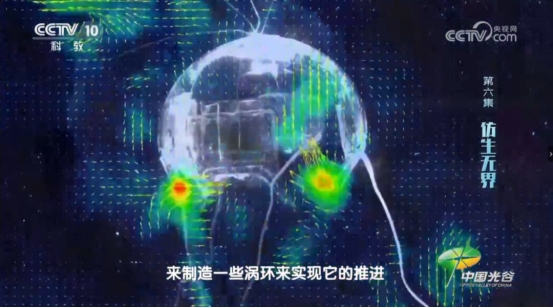
This micro robot, with a diameter of only 120 mm and a weight of merely 56 g, accurately reproduces the agile vortex ring propulsion posture of natural jellyfish through its nearly transparent body and bionic jellyfish muscle structure, achieving highly efficient and near-silent operation underwater.
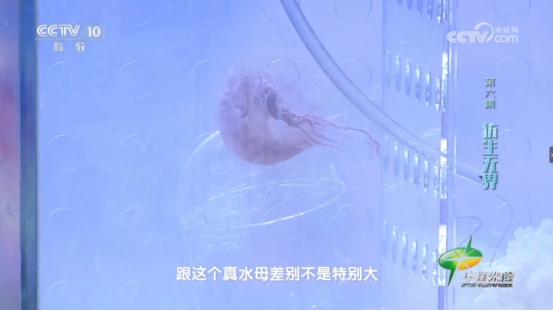
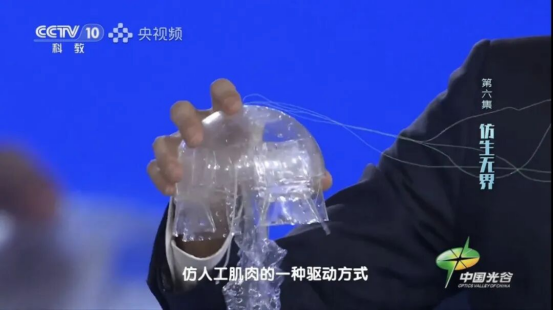
Professor Tao Kai introduced that the core of the jellyfish bionics lies in the team’s self-developed electrohydraulic muscle actuator and innovative hydrogel electrode material. Driven by an electric field, the actuator simulates the contraction and relaxation of jellyfish muscles controlled by neural signals, realizing the expansion and contraction of the bell. This driving method delivers extremely high energy efficiency, with the power consumption of the entire drive array controlled at an ultra-low level of 28.5 mW, laying a solid energy foundation for long-term and covert underwater operations. Adopting the design philosophy of "taking nature as a teacher", it aims to minimize the physical and noise disturbances of equipment to underwater environments, meeting the stringent requirements of deep-sea exploration for concealment and environmental friendliness.
Professor Tao Kai demonstrated the intelligent applications of the robot on site. By integrating a micro camera module and an embedded AI processing chip, the bionic jellyfish robot successfully achieved stable hovering in dynamic underwater environments and accurately identified specific underwater targets (such as the school emblem and clownfish). This function strongly verifies the feasibility of realizing autonomous environmental perception and target recognition on a bionic platform.
Featuring low power consumption, low disturbance and high bionic performance, the robot exhibits unique technical advantages and broad application potential in scenarios such as long-term covert monitoring in deep/coastal waters, observation in ecologically sensitive areas (e.g., coral reef surveys), and fine inspection of underwater facilities in confined spaces. It opens up a new technical pathway to address critical bottlenecks in deep-sea extreme environment exploration, including energy endurance, concealment and environmental compatibility.
The Key Laboratory of Micro-Nano Systems for Aeronautics and Astronautics of the Ministry of Education, where Professor Tao Kai is affiliated, is one of the earliest institutions engaged in micro-electro-mechanical systems research in China. Oriented toward aviation, aerospace and marine engineering, the laboratory is committed to the miniaturization, integration and informatization of equipment. It has undertaken more than 190 projects of various types, including the National Major Scientific Instrument and Equipment Development Project and Key Programs of the National Natural Science Foundation of China, and has won 3 Second Class Prizes of the State Technological Invention Award, 1 First Class Prize of the National Teaching Achievement Award, 5 Provincial and Ministerial First Class Prizes, and 19 Second Class Prizes. In 2024, the laboratory was selected as a national-level innovation team, making new contributions to building a strong country in manufacturing and aerospace.
In the future, the team will continue to deepen research, optimize performance, and promote the wider practical application of this achievement in national urgently needed fields such as deep-sea scientific research and long-term intelligent monitoring of underwater environments.